
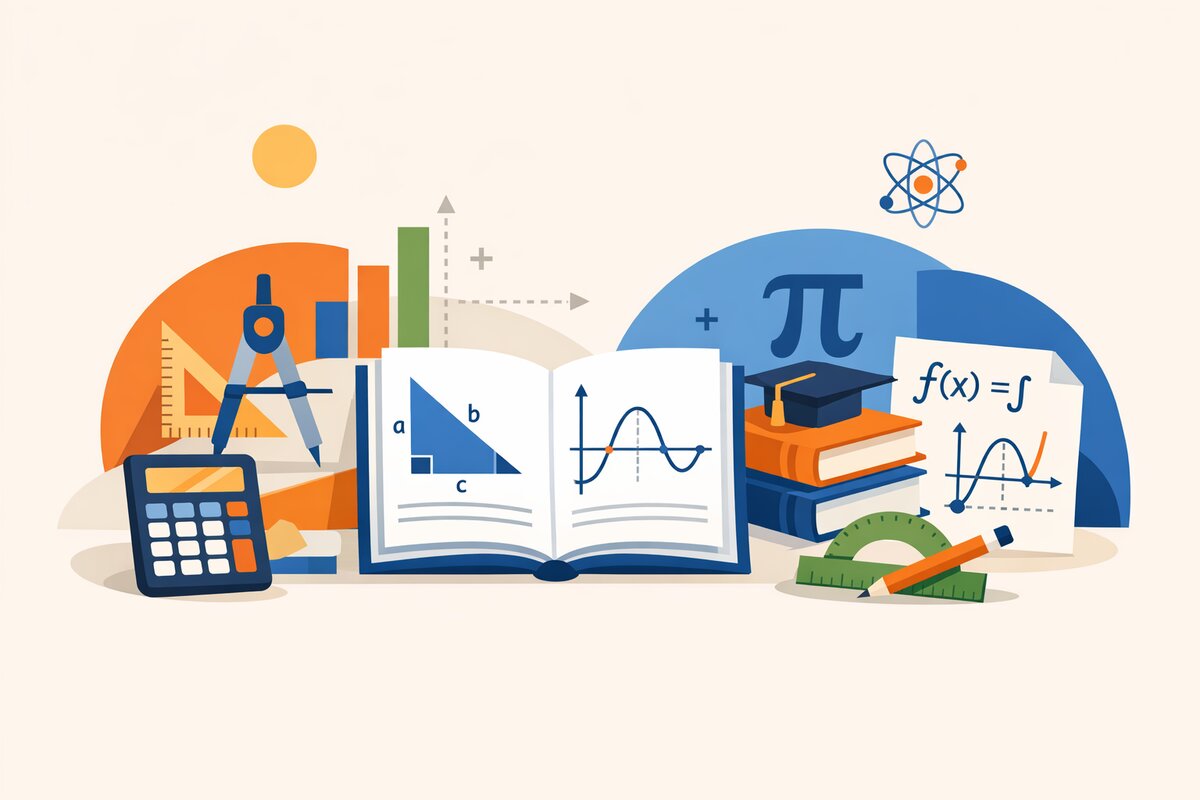
We all know mathematics is not for all, and most people dread this subject. But there are some who can easily score and ace in math. If you have a talent for mathematics and are considering taking up this subject for higher studies, you’re in the right place.
Tons of college readiness math courses are available to help you prepare to score a seat for college and universities. Signing up for those classes can brush up your comprehension and study skills. But today, let’s talk about college-level math to give you an insight into what to expect in these courses!
What Do You Mean By Math For College Readiness?
It simply means a college-level math course to help you prepare for college. These lessons can polish your skills and enhance your ability to solve complex problems. You’ll undoubtedly face enormous challenges in college or university, so ensuring you’re well-prepared for mathematics at the college level can lighten your burden and help you progress without feeling stuck.
Math for college level will help you learn more about algebra, equations, geometry, calculus, trigonometry, etc. Each course will help you prepare for the next allowing you to build a solid math foundation.
These courses are beneficial for students who want to practice and review concepts before pursuing higher studies. Taking these math courses can help you measure your skills by identifying your weak and strong points, making more room to expand your knowledge.
Besides gaining a deeper insight into mathematics, practicing solutions and tricky questions can also improve your mind. Also, taking math courses is an excellent idea for students to have a sound knowledge and understanding of discrete mathematics.
Levels Of Math For College Readiness
In this course, you’ll learn about several more advanced topics, with challenging problem-solving lessons and quizzes compared to what you’ve learned in school. But these courses can help you navigate successfully with helpful advice and hints to strengthen your skills in preparing math for college level.
Here’s what you can expect in math for college readiness.
- Algebra 1 – You’ll first start with Algebra 1 or college algebra during your course. Though algebra may vary across institutions, the learning method is basically the same.
Algebra is essential as it prepares you to understand and solve more complex algebraic equations. These topics cover complex and more advanced equations that are beneficial, especially for those who want to kick-start their career in mathematics.
To progress further, solving basic algebra equations can help you understand more about algebra. Also, you should know that college-level algebra will consist of advanced equations and graphs with challenging questions entirely different from what you were taught in school.
- Algebra 2 – Algebra 2 is the second level or can also be called the continuation of Algebra 1 with additional equations. This course will help you learn about linear equations, quadratic relations, complex numbers, exponential functions, graphs, and polynomials.
Algebra 2 covers comprehensive algebraic principles and detailed explanation that meets the standard required by most colleges. Many students find this topic challenging, but most institutions regard Algebra 2 as a requirement for higher-level classes, like pre-calculus or calculus.
You are required to practice problem-solving to do well in Algebra 2. This course can be demanding, but also there are many ways to learn and improve your skills.
- Trigonometry – In trigonometry, you’ll study graphs of trigonometric functions, oblique triangles, logarithmic functions, and inverse trigonometry, among others.
In a college-level trigonometry course, you’ll focus on studying the sides and angles of a right-angled triangle. The six ratios used in trigonometry are sin, cos, tan, cot, sec, and csc.
Also, trigonometry is one of the most important topics in math as it can be applied to several fields. It’s used in criminology to investigate a crime scene, geography to determine the distance, astrology to measure the distance between stars, etc.
- Geometry – The basic topic in geometry covers understanding lines, shapes, triangles, angles, circles, and geometric constructions. This branch of mathematics is the study of the shape of objects and the relationship between them.
You’ll deal with topics such as Euclidean and non-Euclidean geometries for college-level geometry. Most colleges and universities provide online courses for geometry for several levels or higher study. However, some classes require prerequisites for calculus and trigonometry.
- Precalculus – In this course level, you’ll combine concepts of algebra, trigonometry, and geometry to gain a better understanding for the next course, i.e., calculus. In short, it prepares you with the skills needed to master calculus.
This course can help you apply solutions to real-world problems. By understanding precalculus, you’ll have better chances of understanding advanced mathematical concepts such as polynomial, linear, and trigonometric functions. Or other theories that may not be included in other courses.
As the foundation of calculus, this course helps students prepare for advanced college-level programs.
- Calculus – Calculus is the study of continuous change and is commonly used in physics, economics, medicine, and engineering. It’s a common requirement in most colleges. In this course, a student will make use of all the skills learned in previous courses, which include geometry, algebra, and trigonometry.
This is the reason why calculus can be challenging for most students, as you have to have a solid understanding from the base. Also, this course is vital if you’re considering going for college-level math.
For example, in physics, it is used to calculate and define light, motion, and heat. In chemistry, it studies the movement of planets and gravity. In economics, it can calculate the supply and demand curve, etc.
Conclusion
If you’re academically gifted, chances are you’d want to study math for your higher education. Or if you’ve completed high school and are preparing for college, there are so many math courses available where you can enroll to enhance your skills.
Practice and preparation are all you need to succeed. You could also use the help of video lessons online to rework your mistakes or challenges because that’s how you’ll progress.
FAQs
1. What does math for college readiness mean?
Math for college readiness refers to college-level math courses designed to prepare students for the mathematical demands of higher education, covering topics from algebra and geometry to statistics and calculus.
2. What math topics should students master before college?
Students should be proficient in algebra, geometry, trigonometry, statistics, and basic calculus. Strong problem-solving skills and the ability to apply mathematical concepts to real-world situations are also essential.
3. Are college readiness math courses available online?
Yes, many institutions offer online math readiness courses that allow students to study at their own pace and strengthen their mathematical foundations before starting college.
4. How can students improve their math skills for college?
Students can take college preparatory math courses, practice regularly with problem sets, seek tutoring support, use online resources and practice tools, and focus on understanding concepts rather than memorizing formulas.